The Mediterranean Sea is home to more than 510 million people, yet only a few know that it is currently in danger. Its marine ecosystems are under pressure and climate change plays a significant -if not a major- role in that. In order to investigate the way climate change affects the Mediterranean Sea, we conducted an interview with experts in marine conservation in Turkey and discussed all of the problems the area is facing, while at the same time they provided a couple of possible solutions and effective practices.
According to the State of the Environment and Development in the Mediterranean (SoEDM, 2020), the Mediterranean region is warming 20% faster than the global average, while water temperature is expected to rise by between 1.8°C and 3.5°C by 2100, with hotspots in Spain and the Eastern Mediterranean.
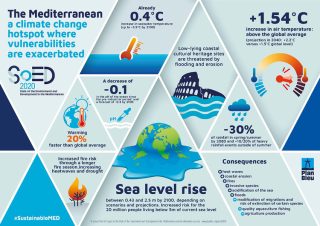
Climate Change in the Mediterranean, SoED 2020
Among others, some of the consequences of climate change in the Mediterranean are heat waves, floods, coastal erosion, and invasive species. Specifically, according to Prof. Dr. Gökoğlu, researcher at the Faculty of Fisheries at Akdeniz University in Antalya, Turkey, the Mediterranean Sea is a vulnerable marine ecosystem in danger.
«The Mediterranean Sea’s ecosystem has changed, especially in the Eastern Mediterranean. It became more tropical. The increased water temperatures had a negative impact on the Posidonia Oceanica meadow, which is vital for the wellbeing of Mediterranean’s marine ecosystems, especially in coastal areas, where the water is shallower and therefore the temperature easily increases», he explained.
According to Mr. Taçyıldız, a certified UNESCO underwater cultural heritage protector and an active scuba-diving instructor, because of the fact that the Mediterranean waters have become more tropical, the lionfish considers them its natural habitat. By coming to the Mediterranean, lionfish not only avoid their natural predators, but they also find the suitable conditions to mate. Therefore, it is estimated that its population will increase in the Mediterranean in the next few years, threatening native fish populations and bringing general imbalance in marine ecosystems and biodiversity.
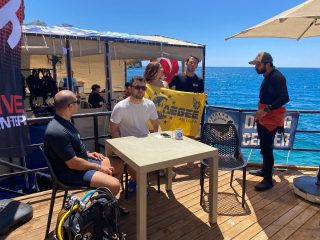
Interview with Mr. Taçyıldız. Antalya, Turkey. (30/05/2026).
«I’ve been diving for the last 17 years almost every single day and, even though I have encountered many marine species, in the last few years I have been encountering new ones that do not belong to the Mediterranean Sea», he stated.
According to Prof. Dr. Gökoğlu, climate change is the main reason for the Lessepsian migration as well, that is the migration of marine species along the Suez Canal, usually from the Red Sea to the Mediterranean. «Increased water temperatures are also the reason for the appearance of 75 new marine species from the Red Sea in the Mediterranean and this number will increase year by year», he stated.
When it comes to solutions, he explained that the scientific community proposed the increase of the Suez Canal’s water salinity, in order to tackle Lessepsian migration. However, this was a very long and expensive procedure, therefore it was disregarded. Nevertheless, for Prof. Dr. Gökoğlu, marine ecosystems can be preserved in other ways, such as by reducing the human use of fossil fuels or by preventing forest fires.
As he told us, currently there are many marine conservation efforts implemented in the country.
«Turkey no longer uses commercial fishing licenses, while fishing quotas have been introduced to certain species, such as the bluefin tuna or the moray eel, in order to prevent overfishing, which brings additional value to the sustainable management of marine resources», he added.
According to Mr. Taçyıldız, a good example of marine cultural and biological heritage preservation is the organization of underwater cleaning festivals, by various diving centers in Turkey twice a year. Another good practice is the construction of artificial reef ecosystems to enhance local biodiversity. Specifically, Prof. Dr. Gökoğlu and his students created an artificial reef by scattered stones and concrete blocks on the seafloor of Konyaaltı Beach in Antalya during 2025, which now serves as a natural habitat for approximately 12 different fish species. The success of this local initiative demonstrates that a simple, yet effective, method for supporting marine species and plantations, offers a promising strategy for marine conservation efforts in the future.
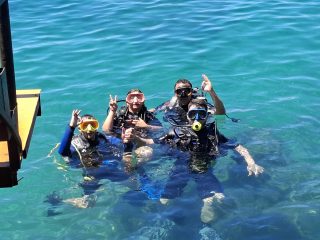
Scuba diving with Mr. Taçyıldız and AEGEE volunteers in Konyaaltı Beach, Antalya, Turkey. (30/05/2026).
For Mr. Taçyıldız, climate behavior is something to be taught.
«Whenever I train other instructors, I always teach them how to behave underwater. For example, I advise them to collect the trash from the sea and to never take away anything that belongs to the marine ecosystem up to the surface. The only thing you can take from beneath with you is pictures. […] As instructors, we also participate in many underwater cleaning activities and we collect the fishermen’s lead out of the sea. That is our goal every time we dive», he said.
After scuba-diving with Mr.Taçyıldız in the bottom of the Konyaaltı Beach in Antalya, I was amazed by the artificial reef Prof. Dr. Gökoğlu and his team constructed. Even though the visibility underwater was not that clear, due to the given conditions, the whole experience made me realize that humans are the ones who pollute, overfish, and destroy, but at the same time it’s also humans who preserve, protect, and advocate for climate justice and animal welfare. I guess it’s up to us to decide which human we want to be.
Thank you Prof. Dr. Gökoğlu and Mr. Taçyıldız for the interview and your service in marine conservation.
Written by: Dimitrios Theologidis
a member of the Lilac Team of Europe on Track 12