Consequences of climate change and human pollution are profound and multidimensional, but not always visible. Sometimes they are evident, like a forest wildfire or a river running dry, while others are less obvious, like the case of Fontanili, the groundwater ecosystems of Northern Italy.
In order to understand the importance of groundwater ecosystems and investigate the way climate change and human behavior have an impact on them, we conducted an interview with Dr. Manuela Lasagna, Associate Professor of Hydrogeology at the University of Turin in Northern Italy, and discussed all of these aspects.
“Groundwater is the water inside the subsoil and we generally use it for drinking purposes. In the Po plain, we have different aquifers, that are the reservoirs in which water is saved. The aquifers are made of gravel and sand, and inside the pores there is the water that we use with the wells. We withdraw it from the wells and apart from drinking purposes, it has irrigation and industrial uses, as well”, Dr. Lasagna explained.
Even though many people believe that fresh water is present only in large lakes and rivers, according to Dr. Lasagna, groundwater is the most important resource, as 95% of fresh water is present in subterranean reservoirs, namely aquifers. That’s why their preservation is vital.
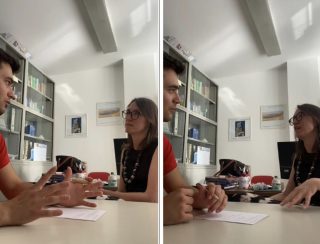
Interview with Dr. Lasagna Manuela at the University of Turin, Italy (12/06/2026).
As Dr. Lasagna explained, an aquifer is divided into the shallow level, that has a lower water quality, and the deep level, which is located underneath the shallow one and has a better water quality. Thanks to the presence of clay that acts as a protective layer, the deep aquifer is more protected from contamination and that is the reason why it gathers a higher water quality. Nevertheless, sometimes the shallow and the deep aquifer are interconnected, thus contamination present in the shallow aquifer is possible to reach the deep one.
“Consequently, in case there is a decrease in the water level of the shallow aquifer, due to climate change, there are repercussions in the deep aquifer, as well. That is the reason why we are studying both of them to understand their sustainability and their resilience in relation to climate change”, she added.
Specifically in Northern Italy, Fontanili are typical lowland springs located along the Po plain from Piedmont to Lombardy, Friuli, and even the Adriatic Sea. Some of their ecological benefits are the self-cleansing of water, stable water temperature, and unique ecosystems. Even though groundwater is more resilient than surface water, it is still affected by climate change and high temperatures. For instance, Fontanili faced a critical situation in 2022, due to climate change, alongside other factors, such as agricultural practices and lack of conservation, that contributed to the overexploitation of the shallow aquifer and to water pollution.
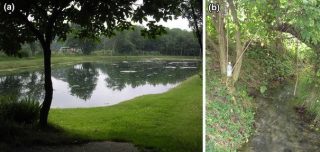
Turin Po Plain Fontanili, Northern Italy.
“During 2021-2022 there was an intense drought all over Europe and this had severe consequences for groundwater ecosystems in Italy. Fontanili completely disappeared, because they are connected to the shallow aquifer, therefore the decrease of the water level inside the subsoil, created a disconnection between the aquifer and the springs. That is a very important problem, as the whole ecosystem that exists in correspondence to the springs was completely vanished”, Dr. Lasagna said.
Along with climate change, human behavior is also one of the reasons why Fontanili are in an alarming situation, especially in the region of Piedmont, where they are located in agricultural areas. According to researchers, collected data has revealed the presence of chemicals unsuitable for human consumption in groundwater ecosystems, especially in wells in areas where land use is more intense.
“In every plain, we have contamination of nitrate, due to the use of pesticides and fertilizers with nitrogen. In Italy, we work a lot to spread awareness to the farmers and to give them some numbers of the acceptable amounts that can be used, in order not to provoke contamination to the soil. […] Even though some kinds of pesticides were banned in the past, we can still find their presence in the aquifers up to this day. Even if they were banned 20 years ago, we would still be able to track their presence. Therefore, I think that it would be a good idea to embrace the use of non-toxic fertilizers, for the sake of our water quality”, she added.
Although Fontanili are extremely useful for the wellbeing of the environment, they are not protected by any law. Therefore, they are not a matter of monitoring, which is the backbone of their preservation.
“If we need to protect a water resource, we have to monitor it first. For example, during the drought, some springs in the Alps ran completely dry and when we were asked to provide a solution, we could not move forward, because we were told that there was no monitoring beforehand”, Dr. Lasagna said.
However, she reaffirmed to us that the monitoring network in Piedmont is quite modern:
“We have more than 100 piezometers in wells, in which the environmental agency measures the level of groundwater continuously. We also have 300 more wells in which two times per year there is a sampling of groundwater for a chemical analysis. Not all of the regions have the same network, but we are lucky to have it”.
At the University of Turin, there is also a scientific platform, a hub of researchers, and Dr. Lasagna is the coordinator of one of these, which is called “Sustainable Water Platform of UniTo”. There are more than 50 researchers from 13 different departments and they all work together and engage the public to find solutions to a very important problem.
“We work in a transdisciplinary way, as we want to involve stakeholders, such as the society, its citizens, lawyers, economists, and local enterprises, as well, and to analyze the problem, not only from a geological, biological, or a chemical point of view, but to establish a partnership of different departments, in which we will work all together to create projects that spread awareness of our groundwater ecosystems and advocate for better policies for the sustainable management of our precious resources”, Dr. Lasagna said.
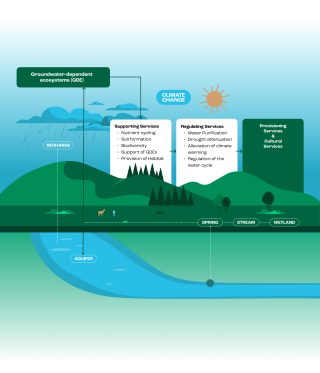
Sentinel Springs (2026).
Another initiative worth mentioning is Sentinel Springs, a project of «Water4All: Water Security for the Planet», which aims to turn springs into early warning systems, securing clean water, ecosystem resilience, and sustainable use for the next generations. The project involves six countries (Denmark, France, Italy, Malta, Poland, and Portugal) and in each one there is a different kind of spring that is selected to be examined. In Italy, the selected case study is Fontanili.
One of its main objectives is to create a protocol that can be used at a pan-European level, for spring monitoring, especially in times of climate change. In Italy in particular, there is a collaboration with ENEA, the Italian National Agency for New Technologies, Energy and Sustainable Economic Development, on analyzing some macro and micro-invertebrates that correspond to groundwater-dependent ecosystems.
“The next step is to understand if there is an ecosystem with good quality or if it is independent and what are the interconnections between them”, she added.
When asked for a message, Dr Lasagna responded:
“I have to say what I say to my students and that is that it’s necessary to spread awareness of the presence of groundwater, because even if it’s an invisible resource, it’s still very important. We have an invisible resource, but we have to make it more visible”.
For me, this is the essence of that article. We all live in an interconnected world, where even the smallest creatures have their own role and significance for the well-functioning of our planet. Therefore, just because a resource, such as underground aquatic ecosystems, is invisible to the human eye, that doesn’t mean that it is not a vital part of our daily lives. That is the reason why we all have to make concessions in our behavior and change the way we perceive and treat nature, for the sake of the air we breathe, the water we drink, and the food we consume. For the sake of the planet we live in, in general.
Thank you very much Dr. Lasagna for this interview and for your service in monitoring and preserving groundwater ecosystems.
Written by: Dimitrios Theologidis
a member of the Lilac Team of Europe on Track 12