The one where we found hope in Sarajevo
Azure Route in Sarajevo, 02/06 - 03/06
Zdravo, ćao from Kadi, Alina and Phaedon, the Azure ambassadors!
Once again, our arrival to our next stop wasn’t really glamorous. After a night bus that delivered us to Sarajevo at a rather questionable hour of 5 a.m., we found ourselves swaying through the city on a trolleybus, trying (and mostly failing) to stay awake and reach our abode for the next few days. The lucky early morning commuters could see three people with their huge backpacks simultaneously nodding off in different directions.
Eventually, we made it to our apartment and were greeted by the lovely local and AEGEE member Ella. Fortunately, the locals had been warned about the state we’d arrive in and, unlike us, had sensible worklives and schedules of their own. This meant we were granted the greatest gift imaginable after a night bus: a long nap.
Looking back, that rest was irreplaceable because Sarajevo turned out to be one of those cities that constantly gives you something new to admire and think about.
Over the next two days, we met members of the newly revived AEGEE-Sarajevo, including Adele (AEGEE-Sarajevo’s president), Kenan, and several other enthusiastic locals who introduced us to their city. Sarajevo wears its history openly. Walking through its streets meant constantly encountering reminders of the past: building facades still bearing the scars of war, the historic bridge linked to the events that sparked the First World War, and the Sarajevo Roses scattered across the city – marks left by deadly mortar shell impacts and later refilled with red resin, serving as poignant memorials to those who lost their lives during the siege.
Another thing we quickly learned was that cash is still king here. This led to one of Phaedon’s side quests of the trip: finding an ATM that didn’t charge alarming fees. Like many great adventures, it involved a lot more walking and exploring than initially anticipated.
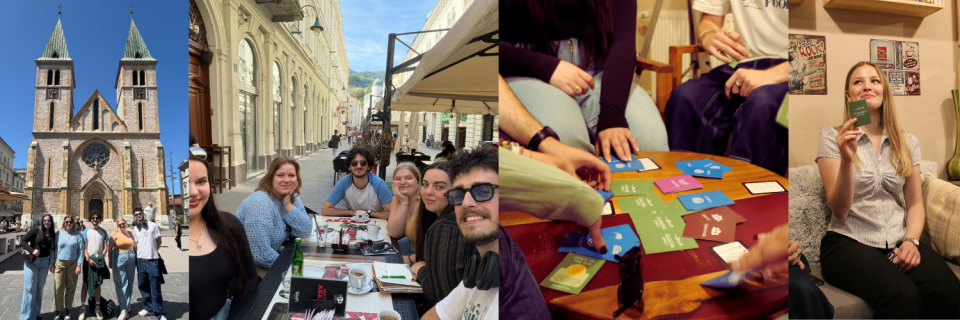
This stop featured a new workshop we hadn’t given yet – Climate Board Games. The participants gathered around a table to play Echoes of Gaia, a climate future-focused board game created by a former AEGEE member. From the very beginning, it became clear that we’d found the perfect audience for it. Participants eagerly stepped into their characters, connected with their spirit cards, and began building entire worlds together. Discussions quickly evolved from game mechanics into philosophy. What kind of future are we imagining? What do the people in this world value? How do they relate to nature? How do they cope and survive?
The game created a space where participants felt comfortable exploring emotions and ideas that don’t often come up in everyday conversation. Several described the experience as therapeutic and cathartic. “Humans aren’t really anything compared to what nature can do, so I’d say I feel insecure” a participant said. It was one of many moments where the game became less about winning and more about understanding our place in the world. Perhaps unsurprisingly, spending the afternoon reflecting on humanity’s relationship with nature made us pay a little more attention to the landscape around us. Inspired by the lush greenery and mountains surrounding us, during dinner we discussed whether it can really be called hiking if there are no mountains involved. My flatlanded Estonian forest-loving heart wasn’t very happy that this was even a debate.
The next day, we had the morning and afternoon off, so we decided to visit the highly praised War Childhood Museum. The museum is composed of personal objects connected to people’s experiences of war, accompanied by the memories and emotions associated with them. We highly recommend a visit. Many of the locals we spoke with also reflected on the war and how deeply intertwined it remains with their culture. Through these conversations we also learned that much of the region’s literature and film remains deeply connected to the war. Books such as Sarajevo Marlboro and films like No Man’s Land were recommended as ways to better understand the country’s recent history.
Some recommendations, however, remained recommendations. Despite our best intentions, we never managed to visit the National Museum and its botanical garden or the cable cars and abandoned bobsled track. Instead, we dedicated some amount of time to another activity that had become increasingly important during our travels.
Laundry.
Fresh clothes begin to feel like an unimaginable luxury. During our short stay, we managed to wash two full loads but also to use a dryer. It is difficult to explain the excitement that wearing freshly washed clothes generated, but that night’s sleep was all the sweeter- and laundry detergent-scented- for it.
Despite being a very recently resurrected local, AEGEE-Sarajevo felt so alive. There was an energy among the members that reminded us how exciting it can be to build something, furthermore a community, from the ground up. It was clear how much value they placed on their community and how much it had already given back to them. Something that also came apparent during our second workshop.
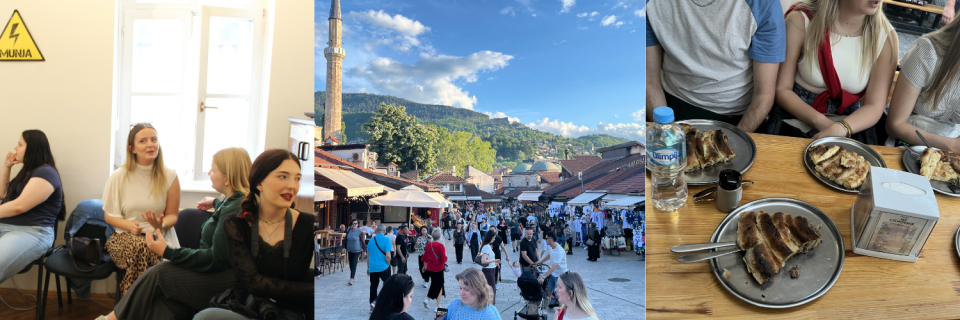
Our second workshop in Sarajevo was Climate Emotions 101. Unlike some of our larger sessions, this workshop took place in a smaller group. At the beginning of the workshop, many participants positioned themselves among emotions such as concern, frustration, and anxiety when discussing climate change. Yet after sharing stories about their cities, communities, and experiences, many had shifted toward emotions associated with hope and empowerment.Showing once again the power that confiding and connecting with a community can have.
Simply hearing that others shared similar concerns seemed to make a difference. The workshop became a reminder that climate emotions are often collective emotions. Sometimes the feeling we’re missing isn’t information or solutions. Sometimes it’s community.
Parallel to the discussion, next-door an interview was taking place by my fellow ambassadors. It was with a local activist, environmentalist, researcher and a mountain guide working alongside the city administration – Ismir Smajić. Much of this conversation focused on education, climate communication, and the importance of connecting people with nature. When discussing eco-anxiety, his perspective was straightforward. He told us that he doesn’t have it. And if we act we won’t have it either. Whether everyone would agree with that conclusion is another question entirely, but it certainly gave us something to think about on our journey onward.
Soon enough, it was time to pack our bags once again and head to our 8 hour bus to Zagreb (where I’m currently writing this report from). We said goodbye to the locals, the green hills surrounding the city, and the countless recommendations we never quite managed to fit into our schedule.
Sarajevo turned out to be a city of conversations. Conversations about history and memory. About nature and community. About climate emotions and collective imagination. And perhaps most importantly, conversations that left us feeling a little more hopeful than before. Until the next stop – ćao!
Written by: Kadi Värnik
(and the Azure team)
1 comment for “Azure Team – Sarajevo”