The one where we stole a duck
Azure Route in Groningen, 12/06 - 14/06
Moi eem from our second dutch city, Groningen!
Rain as soon as we arrived? Yes. I still refuse to get a rain coat, because at this point it feels like admitting defeat. But we were also greeted on the platform by the lovely Joris!
He informed us that we would be renting bikes. As people not entirely accustomed to Dutch cycling culture, the first few metres were admittedly a little wobbly. After surviving those initial moments without crashing into each other or a canal, we felt confident enough to adopt bicycles as our primary mode of transportation for the weekend. Did we get yelled at by locals because of our poor bike etiquette and because we stopped in inconvenient places? Also yes.
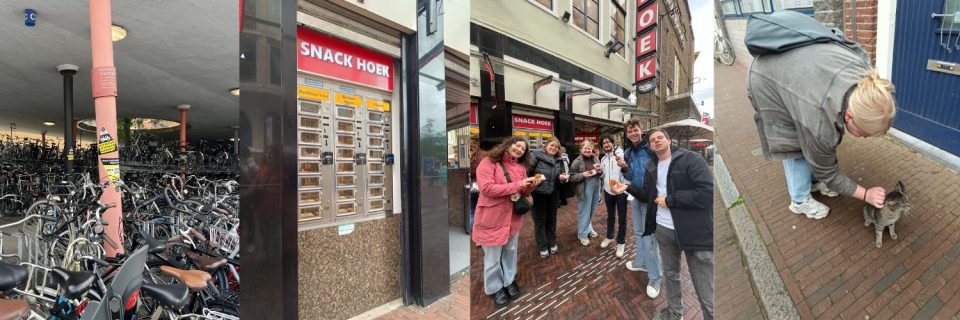
When I asked Joris, “So, what is Groningen known for?” his answer was simply, “Bikes.” I found this funny because, from an outsider’s perspective, the Netherlands as a country seems to be known for bikes. However, Groningen quickly proved that it deserves this reputation. Despite having visited several Dutch cities before, I was still surprised by the sheer number of bikes everywhere.
Our first stop was the AEGEE-Groningen office, which immediately gave us a glimpse into how large and active their local really is. There were several committees, plenty of ongoing activities, and a constant feeling that something was happening. In fact, something was happening that very day besides our EoT workshop: a soup lunch. Some members had made a lovely spiced pumpkin and sweet potato soup, which was genuinely outstanding and exactly what was needed on a rainy Dutch afternoon.
We also heard rumours of another local favourite, a courgette soup, which unfortunately we never got the chance to try ourselves. However, we were kindly given the recipe. As someone coming from Estonia, where summer often leaves families desperately searching for ways to use an endless supply of courgettes, this felt like valuable knowledge to bring home. And unlike the usual souvenirs, it didn’t add any extra weight to my bag on the remaining journey.
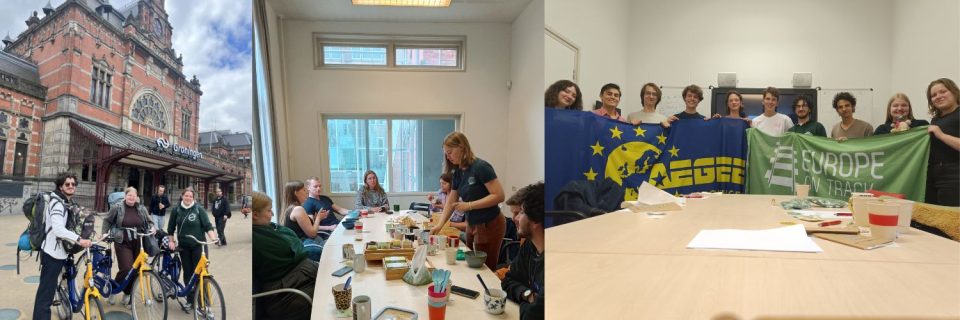
Then we held our workshop, “How to Talk About Climate Without Preaching.” The participants proved to be highly knowledgeable and engaged, which led to several thoughtful and in-depth discussions beyond the planned exercises. One of them focused on outreach strategies: should climate communication aim to move people from low interest to high interest, or should efforts mainly focus on supporting and mobilising people who are already engaged in the cause? Right before the workshop, we learned about Nugget, AEGEE-Eindhoven’s mascot duck, this will come into play later…
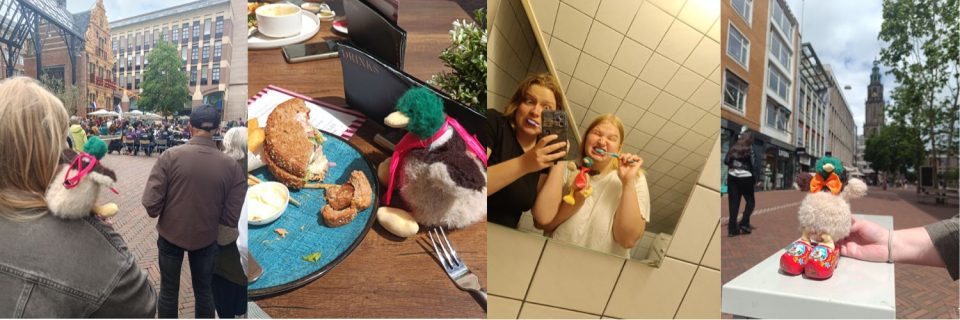
At the end of the workshop, while helping to clean up, we somehow managed to pack Nugget into our workshop bag together with the rest of our materials. Inspired by stories of the Lilac team having “borrowed” a mascot during their route, we felt we had to prove ourselves as well. To be fair, Nugget is incredibly cute. Instead of keeping him hidden away or asking the local for a favour in return, we took him on a little Groningen adventure, including a sleepover, a city tour, and even shopping for clogs. We’re not sure how often Nugget gets out of the office, but we’re certain he had a great day.
Before the route had even started, we had already been warned about one essential Groningen experience: eierballen. Not one person but several people, including our trainer Julian and members from Rotterdam and Delft, had hyped them up. They were not merely presented as a local specialty but described as something extraordinary.
For the uninitiated, an eierball consists of a boiled egg surrounded by a layer of curry ragout and covered in breadcrumbs before being deep-fried. This culinary masterpiece can often be obtained from automated snack walls – those magical little Dutch food lockers that allow you to purchase fried food at any hour while avoiding unnecessary human interaction. The whole thing combined- a show of true dutch innovation.
As someone who considers local grocery stores among the main attractions of any trip, I was equally fascinated by another recommendation: eierbal-flavoured chips sold by the supermarket chain Jumbo. And apparently the locals eat these completely unironically. Unfortunately, despite visiting two separate Jumbo stores, I never managed to find them. This remains one of the great disappointments of the weekend and perhaps one of the greatest mysteries of Groningen.
One of the highlights of the route was the city tour. We were lucky enough to have Joris (another Joris) as our guide. As it turns out, he also works as a city tour guide, and it definitely showed. Actually throughout our route, we had been blessed with some excellent city tour guides. No dry facts for us.
Among the stories he shared were tales of hidden churches tucked away inside the city walls, where people gathered to practise their religion when doing so openly was discouraged and had to remain secret. We also made our way to the rooftop of the Forum building, which offered a fantastic view over Groningen. From there, we could spot many of the places we had visited during the day – and even catch a glimpse of what is claimed to be the world’s biggest football.
We also once again organised our Climate Board Games workshop. Our toolbox contains two games, both developed by the NGO Climate for All. Echoes of Gaia is a storytelling game that invites participants to imagine different futures for humanity and the planet, while Elephant in the Room is a debate game where players step into different roles and perspectives to discuss climate-related topics with their debate. After running the workshop twice before in Bosnia and Hungary, Groningen gave us another opportunity to test the games with a new audience.
During our interviews, we spoke with several workshop participants who brought a lot of knowledge and insight to the conversation. Interestingly, every person we interviewed mentioned feeling some degree of eco-anxiety. This stood out to us because, during our interviews in Rotterdam, climate anxiety had not emerged as such a common theme. It was a reminder that attitudes towards climate change can vary significantly even between different regions and communities within the same country.
In conclusion, Groningen gave us rain, bicycles, climate discussions, local delicacies, hidden history, and one very memorable duck adventure. Not a bad combination for a weekend route.
See you somewhere in Netherlands!
Written by: Kadi Värnik
(and the Azure team)